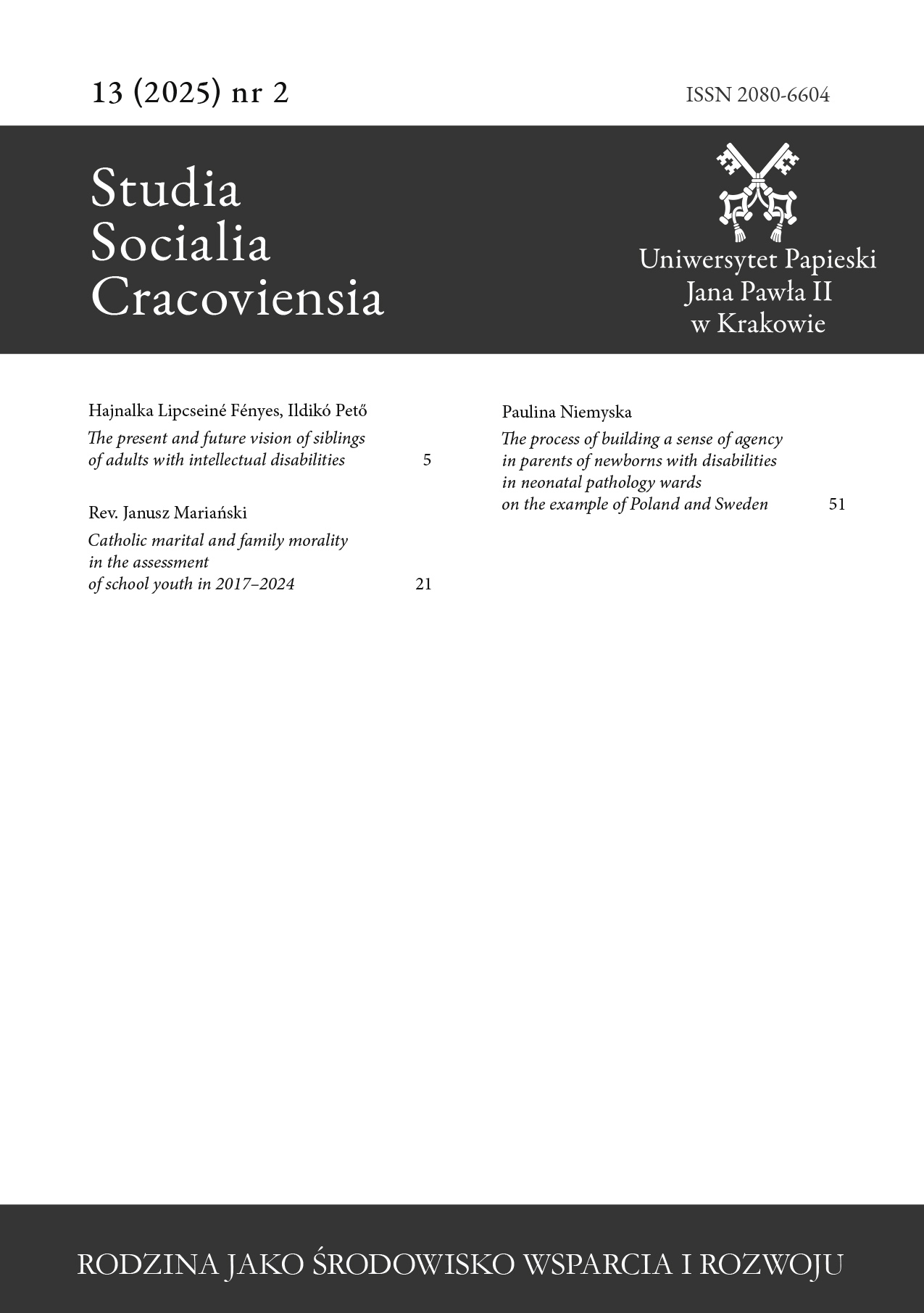
The present and future vision of siblings of adults with intellectual disabilities
DOI:
https://doi.org/10.15633/ssc.13201Słowa kluczowe:
adulthood, intellectual disability, siblings, relationships, vision for the futureAbstrakt
Siblings play an important role in the lives of individuals with intellectual disabilities, as typically developing children can serve as role models and have a positive influence on everyday functioning. As they reach adulthood, non-disabled siblings may become caregivers for their intellectually disabled siblings, taking part in decision-making and assuming increased — or even sole — responsibility for siblings who require support due to the ageing, illness, or death of their parents. This study presents the findings of a semi-structured interview survey conducted in Hungary on the experiences of siblings in adulthood, at a time when their roles within the family are changing or are expected to change. One aim of the broader survey was to explore the responses of 11 siblings in order to understand how they perceive the future: the care of their intellectually disabled sibling and, importantly, the impact of this responsibility on their own personalities. One of the most important findings, which may offer a lesson for the social care system, is that — due to negative societal attitudes and the characteristics of the institutional system — siblings do not view institutional care as an opportunity to support independent living. According to the participants, the influence of their intellectually disabled siblings on their own personality development was positive, making them more accepting and more supportive of other people’s difficulties.
Bibliografia
Armbrust, J. (2013). Testvérviszály: Konfliktuskezelő stratégiák szülőknek. Saxum Könyvkiadó.
Cole, M., & Cole, S. R. (2006). Fejlődéslélektan. Osiris Kiadó.
Doody, M., Hastings, R., O’Neill, S. & Grey, I. (2010). Sibling relationships an adults who have siblings with or without intellectual disabilities. Research in Developmental Disabilities, 31(1), 224–231. https://doi.org/10.1016/j.ridd.2009.09.007
Dorsman, N. I., Waninge, A., van der Schans, C. P., Luijkx, J., & van der Putten, A. A. J. (2023). The roles of adult siblings of individuals with a profound intellectual disability. Journal of Applied Research in Intellectual Disabilities, 36(6), 1308–1318. https://doi.org/10.1111/jar.13149
Hammer, Z. (2016). Tanúk és résztvevők. Változó testvérkapcsolataink. HVG Extra Pszichológia, 4, 16–19.
Hatos, G. (2012). Életkilátás-életkísérés az értelmi akadályozottsággal élők körében. Eötvös Lóránt Tudományegyetem Bárczi Gusztáv Gyógypedagógiai Kar.
Kálmán, Z. (2004). Bánatkő Sérült gyermek a családban. Bliss Alapítvány.
Kálmán, Z., & Könczei, G. (2002). A Taigetosztól az esélyegyenlőségig. Osiris Kiadó.
Pető, I. (2021). Testvérgondozás — felnőtt értelmi fogyatékosokat gondozó testvérek. Különleges Bánásmód — Interdiszciplináris folyóirat, 7(2), 111–121. https://doi.org/10.18458/KB.2021.2.111
Petri, H. (2015). Testvérek: Szeretet és versengés. Életünk leghosszabb kapcsolata. Dialóg Campus Kiadó.
Radványi, K. (2013). A legbelső kör: A család. ELTE Eötvös Kiadó.
Rossiter, L., & Sharpe, D. (2001). The siblings of individuals with mental retardation: A quantitative integration of the literature. Journal of Child and Family Studies, 10(1), 65–84. https://doi.org/10.1023/A:1016629500708
Shivers, C. M., & Dykens, E. M. (2017). Adolescent siblings of individuals with and without intellectual and developmental disabilities: Self-reported empathy and feelings about their brothers and sisters. American Journal on Intellectual and Developmental Disabilities, 122(1), 62–77. https://doi.org/10.1352/1944-7558-122.1.62
Stipkovits, E. (2017). Ölelni és ölre menni Testvérekről, nem csak szülőknek. HVG Kiadó.
Pobrania
Opublikowane
Numer
Dział
Licencja
Prawa autorskie (c) 2025 Lipcseiné Fényes Hajnalka, Pető Ildikó

Utwór dostępny jest na licencji Creative Commons Uznanie autorstwa 4.0 Międzynarodowe.
Autorzy publikujący w czasopiśmie udzielają jego wydawcy zgody o następującej treści:
- Autor zachowuje autorskie prawa majątkowe do utworu, a jednocześnie udziela wydawcy czasopisma zgody na jego pierwszą publikację w wersji drukowanej i wersji online na licencji Creative Commons Uznanie autorstwa 4.0 Międzynarodowe oraz zgody na wykonywanie opracowań, w tym przekładów.
- Autor ma możliwość udzielania zgody niewyłącznej na opublikowanie utworu w wersji, która ukazała się w czasopiśmie (np. zamieszczenia go w repozytorium instytucjonalnym lub opublikowania w książce), wraz z informacją o jego pierwszej publikacji w czasopiśmie.