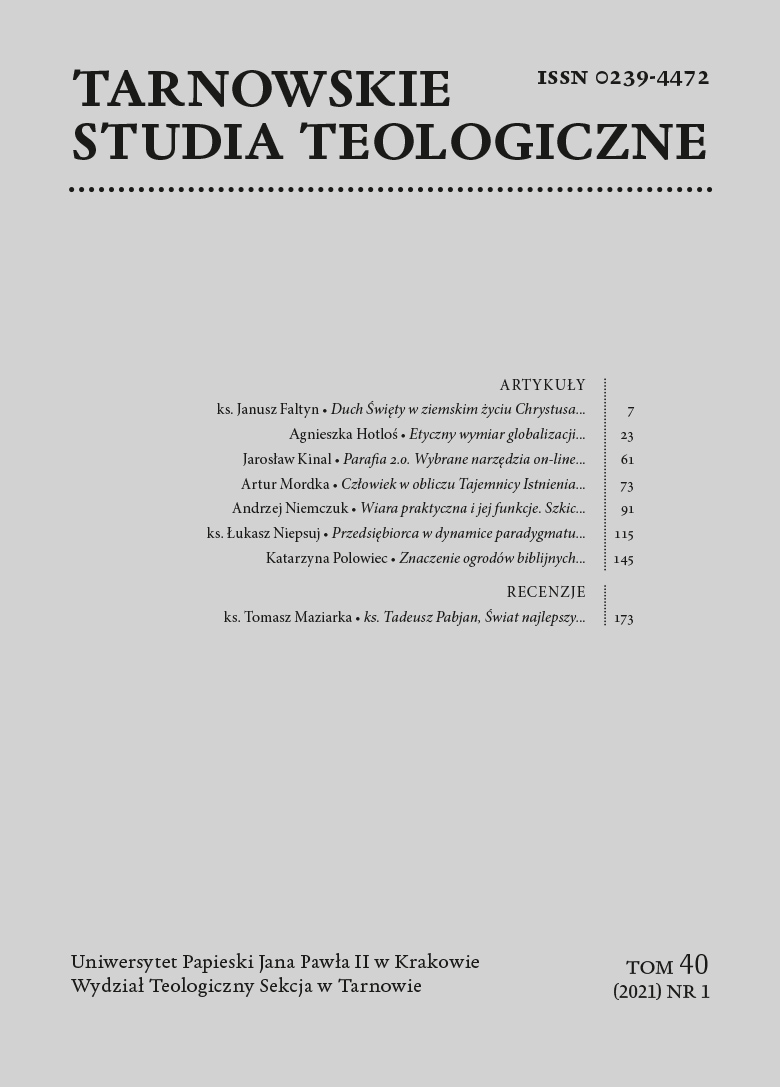
Practical faith and its functions. A philosophical sketch
DOI:
https://doi.org/10.15633/tst.40105Keywords:
practical faith, moral faith, philosophical faith, freedom, naturalistic error, Kant, Kierkegaard, JaspersAbstract
This article contains a sketch of the concept of practical faith and a presentation of two important functions that this concept can perform in practical philosophy. The idea of practical faith is a synthesis based on the interpretation of three concepts of faith: moral faith from Kant’s philosophy, religious faith, on which the so-called „third stage” of life in Kierkegaard’s thought is based, and philosophical faith presented in Jaspers’ philosophy. The author presents these functions of practical faith, due to which it transcends the sphere of descriptive knowledge. For practical philosophy these functions are of major importance because they are the source of subject acceptance of the first principles of this philosophy, i.e. the thesis of human freedom and the thesis of the existence of the sphere of value (different than the sphere of facts and objects). If a philosophy of value were logically based on practical faith, it would be free from the charge of the naturalistic error in axiology.
References
Copleston F., Historia filozofii, tłum. J. Marzęcki, t. 4, Warszawa 1995.
Janeczek S., Integralność poznania ludzkiego w ujęciu Błażeja Pascala. Z dziejów filozofii zdrowego rozsądku, „Studia Philosophiae Christianae” 51 (2015) nr 4, s. 5–73.
Jaspers K., Rozum i egzystencja. Nietzsche a chrześcijaństwo, tłum. C. Piecuch, Warszawa 1991.
Jaspers K., Wiara filozoficzna, tłum. zbiorowe, Toruń 1995.
Jaspers K., Wiara filozoficzna wobec objawienia, tłum. G. Sowiński, Kraków 1999.
Kant I., Krytyka władzy sądzenia, tłum. J. Gałecki, Warszawa 1986.
Kant I., Religia w obrębie samego rozumu, tłum. A. Bobko, Kraków 1993.
Kant I., Uzasadnienie metafizyki moralności, tłum. M. Wartenberg, Warszawa 1984.
Kierkegaard S., Albo-albo, tłum. J. Iwaszkiewicz, t. 1, Warszawa 1982.
Kierkegaard S., Bojaźń i drżenie. Choroba na śmierć, tłum. J. Iwaszkiewicz, Warszawa 1969.
Kierkegaard S., Powtórzenie, tłum. B. Świderski, Warszawa 1992.
Niemczuk A., Błąd teoretyzmu w aksjologii, w: A. Niemczuk, Filozofia praktyczna. Studia i szkice, Lublin 2016, s. 13–45.
Niemczuk A., Wolność egzystencjalna: Kant i Kierkegaard, Lublin 1995.
Paci E., Fenomenologia doświadczenia estetycznego, etycznego i religijnego u Kierkegaarda, w: E. Paci, Związki i znaczenia. Eseje wybrane, tłum. S. Kasprzysiak, Warszawa 1980, s. 433–546.
Pascal B., Myśli, tłum. T. Żeleński-Boy, Warszawa 1972.
Rudziński R., Człowiek w obliczu nieskończoności. Metafizyka i egzystencja w filozofii Karla Jaspersa, Warszawa 1980.
Św. Tomasz z Akwinu, Suma teologiczna, t. 15: Wiara i nadzieja, tłum. P. Bełch, London 1966.
Tarnowski K., Gabriela Marcela filozofia wiary, „Analecta Cracoviensia” 21–22 (1989–1990), s. 99–114.
Tatarkiewicz W., Historia filozofii, t. 2, Warszawa 1978.
Tillich P., Dynamika wiary, tłum. A. Szostkiewicz, Poznań 1987.
Downloads
Published
Issue
Section
License
Copyright (c) 2021 Andrzej Niemczuk

This work is licensed under a Creative Commons Attribution 4.0 International License.
Authors who publish with this journal agree to the following terms:
- Authors retain the copyright and full publishing rights without restrictions, and grant the journal right of first publication with the work simultaneously licensed under a Creative Commons Attribution 4.0 International License that allows others to share the work with an acknowledgement of the work's authorship and initial publication in this journal.
- Authors are able to enter into separate, additional contractual arrangements for the non-exclusive distribution of the journal's published version of the work (e.g., post it to an institutional repository or publish it in a book), with an acknowledgement of its initial publication in this journal.