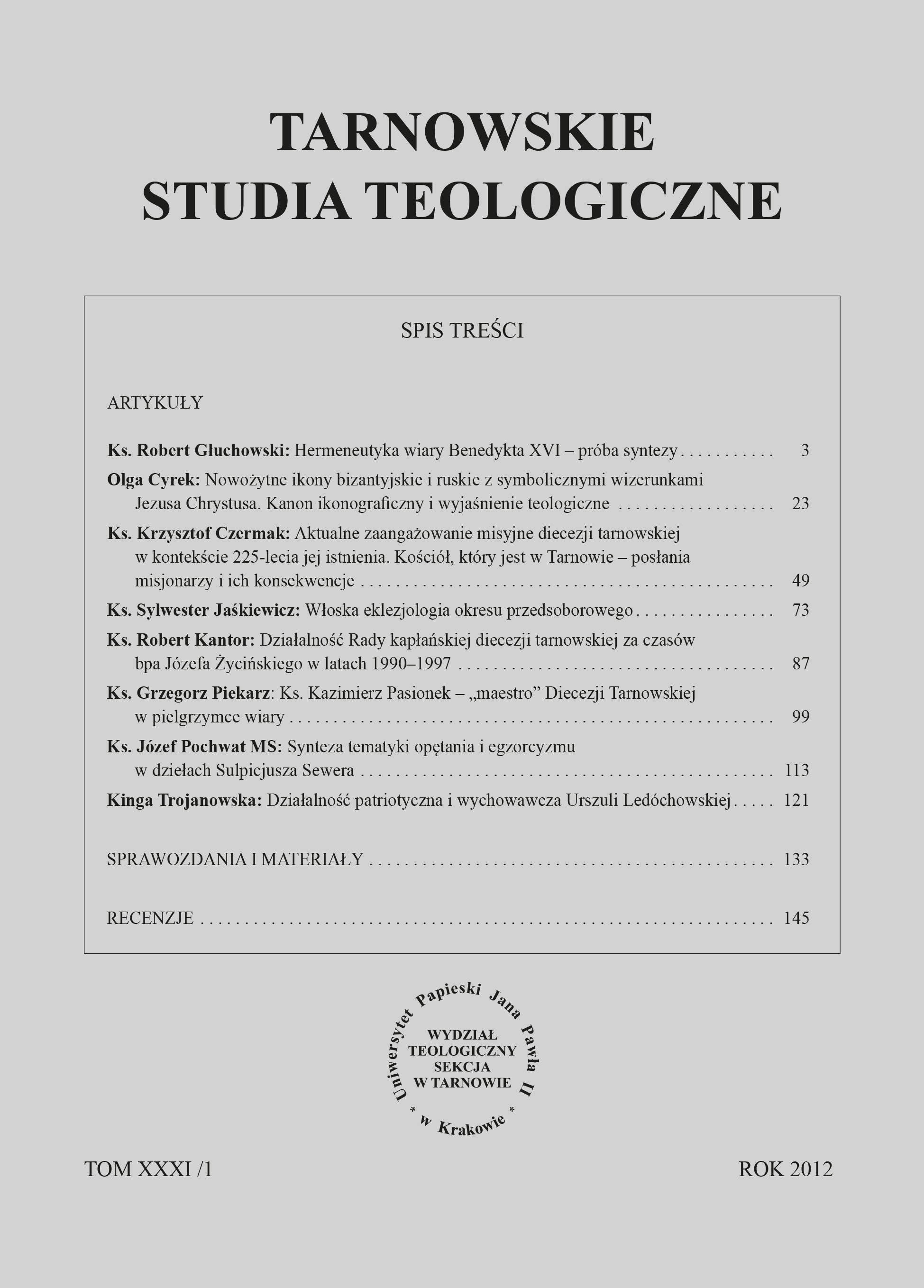
Possesion and Exorcism in the Works of Sulpicius Severus
DOI:
https://doi.org/10.15633/tts.283Keywords:
possession, exorcism, exorcist, the devil, demon, evil spirit, prayer, the monkAbstract
This article contains thoughts of Sulpicius Severus (ca 360–420) with regard to the influence of evil spirits on man. Based on the knowledge of St. Martin of Tours, who had much to do with demons. Sulpicius presented a number of human cases of demonic possession by an evil spirit. Most cases he described were about man’s release from possession.
Sulpicius Severus was demonstrating that when Satan masters a man he takes away his freedom, a fundamental value, which comes from God. In the face of the numerous cases of enslavement of people by Satan, God’s intervention was needed. Sulpicius was convinced that God has equipped some people to be exorcists, with the gift of releasing the possessed from the power of the devil.
Downloads
Published
Issue
Section
License
Copyright (c) 2012 Józef Pochwat

This work is licensed under a Creative Commons Attribution 4.0 International License.
Authors who publish with this journal agree to the following terms:
- Authors retain the copyright and full publishing rights without restrictions, and grant the journal right of first publication with the work simultaneously licensed under a Creative Commons Attribution 4.0 International License that allows others to share the work with an acknowledgement of the work's authorship and initial publication in this journal.
- Authors are able to enter into separate, additional contractual arrangements for the non-exclusive distribution of the journal's published version of the work (e.g., post it to an institutional repository or publish it in a book), with an acknowledgement of its initial publication in this journal.