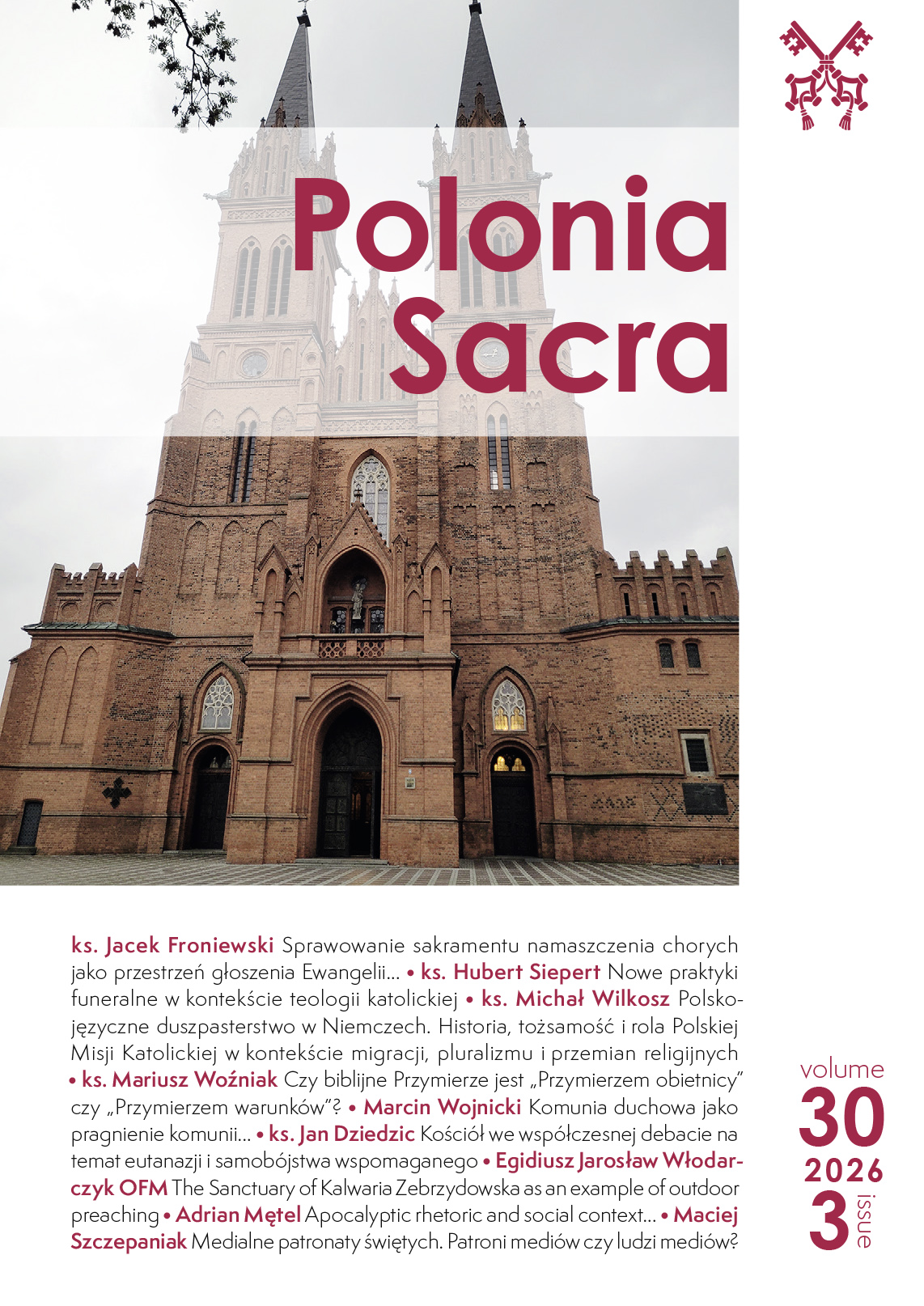
Patron saints of the media. Patrons of the media or of media professionals?
DOI:
https://doi.org/10.15633/ps.30309Keywords:
mass media, patronage, saints, journalism, InternetAbstract
In the history of the Church, the cult of saints is associated with the custom of patronage, i.e. entrusting groups of people — residents of a given territory, members of associations or professional groups — to the care of a particular saint. The patron became an important element of a community’s identity and served as a reminder of their ethical responsibility for their work. In 1923, Pope Pius XI declared St Francis de Sales the patron of Catholic writers; in 1952, St Gabriel was proclaimed the patron of telecommunications; and in 1958, St Clare was designated the patron saint of television. This article addresses the question of these patronages in the light of papal statements issued since their proclamation. The magisterial method was used to achieve the intended goal. The primary motive for establishing these patronages was the protection believed to be offered by the saints. The patronages were also intended to provide moral guidance, as the saints were presented as spiritual guides for journalists and as models of ethical responsibility and trustworthiness in social communication. There is also no doubt that a patronage, even when associated with technological devices, ultimately concerns the people who use them.
References
All’Associazione di S. Francesco di Sales. La circolare del Comitato — Statuto — Iscrizioni, „L’Osservatore Romano” 65 (1925) n. 78, s. 2.
Baragli E., Comunicazione, comunione e Chiesa, Roma 1973.
Benedykt XVI, Orędzie na XLV Światowy Dzień Środków Społecznego Przekazu, 24.01.2011, „L’Osservatore Romano” (wyd. pol.) 32 (2011) n. 3, s. 8–10.
Codex iuris canonici Pii X Pontificis Maximi iussu digestus, Benedicti Papae XV auctoritate promulgatus, 27.05.1917, „Acta Apostolicae Sedis” 9 (1917) pars 2, s. 1–593.
Controverses de S. François de Sales, evesque de Geneve […] Edition première, A Paris, Chez Frederic Leonard, 1672.
Cronaca contemporanea. Cose italiane, „Civiltà Cattolica” 76 (1925) n. 2, s. 176–182.
Decreta authentica Congregationis Sacrorum Rituum: ex actis eiusdem collecta eiusque auctoritate promulgata sub auspiciis SS. Domini Nostri Leonis Papae XIII, vol. 1: 1588–1705, Romae 1898.
Estaunié É., Traité pratique de télécommunication électrique, Paris 1904.
Euzebiusz z Cezarei, Historia kościelna, tłum. A. Caba, A. Lisiecki, Kraków 2013.
Filippo Soccorsi SJ do kard. Clemente Micara, 20.11.1950, Archivio Storico del Dicastero delle Cause dei Santi, R 56/50.
Franciszek, List apostolski Totum amoris est w czterechsetną rocznicę śmierci świętego Franciszka Salezego, 28.12.2022, https://www.vatican.va/content/francesco/pl/apost_letters/documents/20221228-totum-amoris-est.html (30.12.2025).
Franciszek, Orędzie na LV Światowy Dzień Środków Społecznego Przekazu, 23.01.2021, https://www.vatican.va/content/francesco/pl/messages/communications/documents/papa-francesco_20210123_messaggio-comunicazioni-sociali.html (30.12.2025).
Franciszek, Orędzie na LVII Światowy Dzień Środków Społecznego Przekazu, 24.01.2023, https://www.vatican.va/content/francesco/pl/messages/communications/documents/20230124-messaggio-comunicazioni-sociali.html (30.12.2025).
Franciszek Salezy, Filotea. Wprowadzenie do życia pobożnego, tłum. H. Libiński, Kraków 2024.
Giovanni Paolo II, Discorso ad un gruppo di giornalisti cattolici, 10.02.1989, https://www.vatican.va/content/john-paul-ii/it/speeches/1989/february/documents/hf_jp-ii_spe_19890210_giornalisti-cattolici.html (20.02.2026).
Joannes PP. XXIII, [Allocutiones] Ad scriptorum collegium ephemeridis „L’Osservatore Romano” aliosque catholicos diurnarios scriptores a Beatissimo Patre coram admissos, 27.01.1963, „Acta Apostolicae Sedis” 55 (1963), s. 99–105.
Joannes PP. XXIII, [Allocutiones] Iis qui interfuerunt Conventui III Nationali de catholicorum scriptis, cotidie vel in dies certos vulgatis, 4.05.1959, „Acta Apostolicae Sedis” 51 (1959), s. 359–362.
Ks. Joseph Schneuwly do ks. Albino Galletto, 3.01.1957, Archivio Apostolico Vaticano, Anno 1950 SGG, Curia Romana, pos. 179, k. 7.
Leksykon liturgii, oprac. B. Nadolski, Poznań 2006.
Leon XIV, Encyklika Magnifica humanitas o trosce o osobę ludzką w dobie sztucznej inteligencji, 15.05.2026, https://www.vatican.va/content/leo-xiv/pl/encyclicals/documents/20260515-magnifica-humanitas.html (20.05.2026).
Lettera della Segreteria di Stato, w: E. Baragli, Comunicazione, comunione e Chiesa, Roma 1973, s. 442–443.
List bp. Stanisława Adamskiego do dyrektora Polskiego Radia Romana Starzyńskiego, 3.09.1937, Archiwum Archidiecezjalne w Katowicach, KBA 82, k. 97.
List bp. Stanisława Adamskiego do kard. Augusta Hlonda, 18.09.1937, Archiwum Archidiecezjalne w Katowicach, KBA 82, k. 101.
McLuhan M., Galaktyka Gutenberga. Tworzenie człowieka druku, tłum. A. Wojtasik, Warszawa 2019.
Moro E., La storia di Carlo Acutis, il santo patrono di Internet (nonché primo santo Millennial della storia della Chiesa), Elle, 08.09.2025, https://www.elle.com/it/magazine/a66010492/storia-carlo-acutis-canonizzato-papa-leone/ (24.03.2026).
Nota iniziale, 30.05.1955, Archivio Apostolico Vaticano, Anno 1950 SGG, Curia Romana, pos. 179, k. 2.
Paolo VI, Discorso ai membri dell’Unione Cattolica Stampa Italiana, 23.01.1969, https://www.vatican.va/content/paul-vi/it/speeches/1969/january/documents/hf_p-vi_spe_19690123_stampa-cattolica.html (20.03.2026).
Paulus PP. VI, Epistula apostolica Sabaudiae gemma, 29.01.1967, „Acta Apostolicae Sedis” 59 (1967), s. 113–123.
Pius PP. IX, Breve Dives in misericordia, 16.11.1877, „Acta Sanctae Sedis” 10 (1877), s. 411–415.
Pius PP. XI, Litterae encyclicae Rerum omnium perturbationem, 26.01.1923, „Acta Apostolicae Sedis”, 15 (1923) nr 2, s. 49–63; tłum. pol. Encyklika Rerum omnium perturbationem, tłum. P. Borkowski, „Rocznik Tomistyczny” 12 (2023) nr 1, s. 283–293.
Pius PP. XII, Litterae apostolicae Clarius explendescit, 14.02.1958, „Acta Apostolicae Sedis” 50 (1958), s. 512–513.
Pius PP. XII, Litterae apostolicae Quoniam omne datum, 12.01.1952, „Acta Apostolicae Sedis” 44 (1952), s. 216–217.
Pius PP. XII, Litterae encyclicae De re cinematographica, radiophonica ac televisifica Miranda Prorsus, 8.09.1957, „Acta Apostolicae Sedis” 49 (1957), s. 765–805; tłum. pol. Kościół a kultura masowa, red. F. Adamski, Kraków 1984, s. 237–261.
Rutkowski A., Patron, w: Encyklopedia katolicka, t. 15, E. Gigilewicz, Lublin 2011, kol. 59–60.
Seweryniak H., Teologie na „progu domu”, „Kultura — Media — Teologia” 2010 nr 1, s. 9–22.
Sobór Watykański II, Dekret Inter mirifica o środkach społecznego przekazywania myśli, 4.12.1963.
Św. Izydor — patron Internetu, internautów, informatyków, programistów, Katolickie Stowarzyszenie Dziennikarzy w Łodzi, https://katolickie.media.pl/index.php/publikacje/komunikaty-i-informacje/9349-w-izydor-p-a-t-r-o-n-internetu-internautow-informatykow-programistow (24.03.2026).
Traité de l’Amour de Dieu. Par Mgr François de Sales Evêque & Prince de Genève. A Lyon, Chez Pierre Rigaud, 1616; tłum. pol.: Święty Franciszek Salezy, Traktat o miłości Bożej, tłum. M. B. Bzowska, Kraków 2002.
.1375. rocznica narodzin dla Nieba św. Izydora z Sewilli — Patrona Internetu i Internautów, https://www.ekai.pl/rocznica-narodzin-dla-nieba-sw-izydora-z-sewilli-patrona-internetu-i-internautow/ (24.03.2026).
Downloads
Published
Issue
Section
License
Copyright (c) 2026 Maciej Szczepaniak

This work is licensed under a Creative Commons Attribution 4.0 International License.
Authors who publish in this journal agree to the following terms:
- Authors retain the copyright and full publishing rights without restrictions and grant the journal right of first publication with the work simultaneously licensed under a Creative Commons Attribution 4.0 International License that allows others to share the work with an acknowledgement of the work's authorship and initial publication in this journal.
- Authors are able to enter into separate, additional contractual arrangements for the non-exclusive distribution of the journal's published version of the work (e.g., post it to an institutional repository or publish it in a book), with an acknowledgement of its initial publication in this journal.