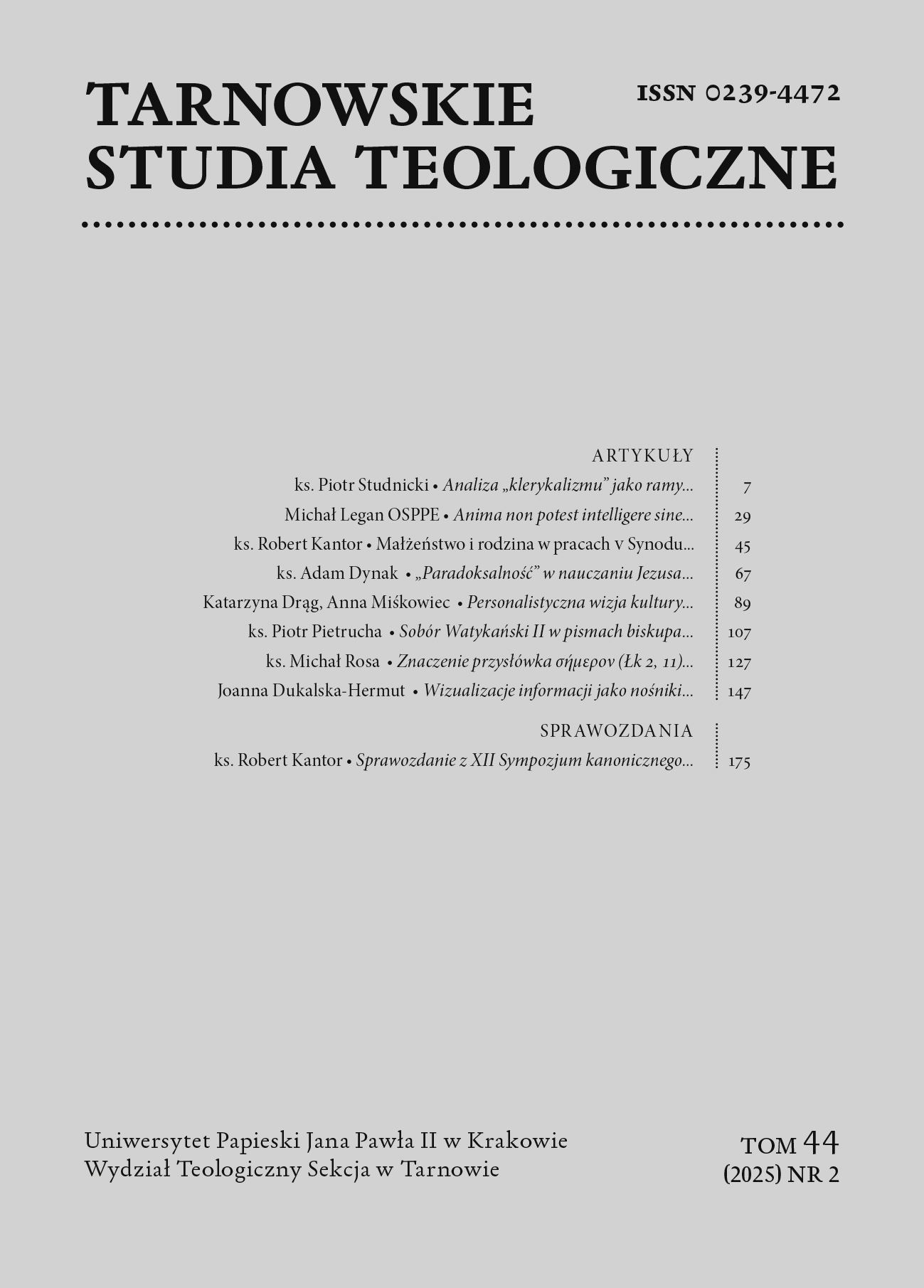
“Anima non potest intelligere sine phantasmate”. On the role of the image in religious experience
DOI:
https://doi.org/10.15633/tst.44202Keywords:
Religious image, religious symbolism, religious experience, the sacred (sacrum), psychology of religion, philosophy of religion, Christian theology, transcendenceAbstract
The article offers an interdisciplinary analysis of religious experience as a complex phenomenon that requires psychological, philosophical, and theological perspectives. Religious experience is presented as a “total psychic phenomenon” that engages the whole person and is oriented toward the sacred—a transcendent reality revealed through signs, symbols, and images. The author emphasizes its personal and dialogical character in Christianity and distinguishes it from other boundary experiences, while acknowledging their preparatory role. A central focus of the article is the role of the image as a privileged medium of religious cognition, which not only represents but makes present transcendence. The discussion is situated within the Augustinian and Thomistic traditions as well as the theology of Karl Rahner, with particular attention to the principle “anima non potest intelligere sine phantasmate”. The article also highlights the pastoral significance of symbol and aesthetics in the transmission of faith, concluding that religious experience is an integral, personal encounter rooted in a relationship with God, in which the role of the image is constitutive.
References
Arystoteles, De anima (O duszy).
Chrystus Wybawiający. Teologia świętych obrazów, red. A. Napiórkowski, Kraków 2003.
Dajczer T., Buddyzm w swojej specyfice i odrębności wobec chrześcijaństwa, Warszawa 1993.
Daniélou J., Bóg i my, Kraków 1965.
Eliade M., Sacrum i profanum. O istocie religijności, tłum. B. Baran, Warszawa 1999.
Eliade M., Traktat o historii religii, tłum. J. Wierusz-Kowalski, Warszawa 1966.
Fischer J. A., How to read the Bible, New York 1881.
Forstner D., Świat symboliki chrześcijańskiej, tłum. W. Zakrzewska, P. Pachciarek, R. Turzyński, Warszawa 1990.
Guardini R., Die Sinne und die Religiose Erkenntnis, Würzburg 1958.
Jan od Krzyża, Żywy płomień miłości, w: Jan od Krzyża, Dzieła, tłum. B. Smyrak OCD, Kraków 1986.
Johnston R. K., Reel spirituality: Theology and film in dialogue, Grand Rapids 2000.
Kłoczowski J. A., Między samotnością a wspólnotą, Tarnów 1994.
Lambruschini F., Rola współczesnego widowiska w życiu moralnym chrześcijanina, w: Kościół a kultura masowa, red. F. Adamski, Kraków 1984, s. 41–55.
Makselon J., Psychologia dla teologów, Kraków 1990.
Merton T., Szukanie Boga, tłum. P. Parlej i in., Kraków 1988.
Niebuhr H. R., The responsible self, New York 1963.
Otto R., Świętość. Elementy irracjonalne w pojęciu bóstwa i ich stosunek do elementów racjonalnych, tłum. B. Kupis, Warszawa 1999.
Rahner K., Vom Hören und Sehen, Würzburg 1969.
Rogowski C., Hermeneutyczno-dydaktyczny wymiar symbolu i implikacje pedagogiczno-religijne, Lublin 1999.
Słownik symboliki biblijnej, red. L. Ryken i in., Warszawa 2003.
Szymołon J., Lęk i fascynacja, Lublin 1999.
Tomasz z Akwinu, Summa theologiae.
Wojtyła K., Osoba: przedmiot i wspólnota, „Roczniki Filozoficzne” 24 (1976) nr 2, s. 25–39.
Zdybicka Z. J., Człowiek i religia. Zarys filozofii religii, Lublin 1993.
Zwoliński A., Obraz w relacjach społecznych, Kraków 2004.
Downloads
Published
Issue
Section
License
Copyright (c) 2025 Michał Legan

This work is licensed under a Creative Commons Attribution 4.0 International License.
Authors who publish with this journal agree to the following terms:
- Authors retain the copyright and full publishing rights without restrictions, and grant the journal right of first publication with the work simultaneously licensed under a Creative Commons Attribution 4.0 International License that allows others to share the work with an acknowledgement of the work's authorship and initial publication in this journal.
- Authors are able to enter into separate, additional contractual arrangements for the non-exclusive distribution of the journal's published version of the work (e.g., post it to an institutional repository or publish it in a book), with an acknowledgement of its initial publication in this journal.